

Table of Contents
- Monasteries in Sikkim
- Rumtek Monastery Overview
- History of Rumtek Monastery
- Architecture of Rumtek Monastery
- Best Time to Visit Rumtek Monastery
- How to Reach Rumtek Monastery
Monasteries in Sikkim
Sikkim is well known for its spiritual and religious heritage, especially when it comes to Tibetan Buddhism. This tiny state in north eastern India has around 200 monasteries big and small scattered throughout its length and breadth. These monasteries (gompas) are living testament to people’s faith and practices continued throughout centuries. Other than being spiritual centres and pilgrimage sites, these monasteries are also wonderful tourist attractions. One can see traditional Himalayan arts, rituals, murals, and paintings inside the monasteries of Sikkim.
This blog sheds light on Rumtek Monastery, the largest monastery in Sikkim, its history, architecture, best time to visit and how to reach there?
Rumtek Monastery Overview
As mentioned earlier, Rumtek monastery in Sikkim is the largest monastery to exist till date.
It is the seat of His Holiness the Gyalwa Karmapa of the Kargyu sect of Buddhism. This eighteenth-century monastery has been a remarkable site ever since its inception. Even today, people (both devotees and tourists) feel tranquil and peaceful while visiting here and get to learn about the history, arts, and culture surrounding Tibetan Buddhism. Let’s learn more details about Rumtek monastery.
History of Rumtek Monastery
With the patronage of the king, the fourth Chogyal Gyurmed Namgyal, Wangchuk Dorje, the 9th Karmapa, established Rumtek Monastery in 1734. By 1956, the monastery’s condition became dilapidated and needed renovation.
Years later, the 16th Karmapa, along with Mipham Chokyi Lodro, His Holiness the 14th Kunzig Shamar Rinpoche arrived in Sikkim and was offered several sites to establish the seat of Karmapa. Out of all the sites offered, he selected Rumtek since it has everything auspicious needed for the activities of a Karmapa.
There were seven streams flowing towards the monastery and a mountain was behind it. There were seven hills facing the Rumtek Monastery and there were snow ranges in front and a river below. The monastery was on a spiralling swirling hill which made a conch-shell like structure. It seemed that nature and number 7 (number of spirituality) had already blessed this place.
The Maharaja of Sikkim gifted 74 acres of land at the Rumtek site to the 16th Karmapa. Sikkim’s government also donated money for roads, electricity, water, and other amenities. The government of India also issued grants to rebuild the essential centres inside monasteries such as living quarters and prayer halls. People of Sikkim also generously donated to rebuild the monastery.
After collective efforts and a period of four years, the Rumtek Monasteries reconstruction was completed in traditional Tibetan style. The 16th Karmapa and his followers managed to save the entire 108-volume canon of the Buddha’s teachings along with texts, statues, and other relics that are stored safely inside the monastery.
Architecture of Rumtek Monastery
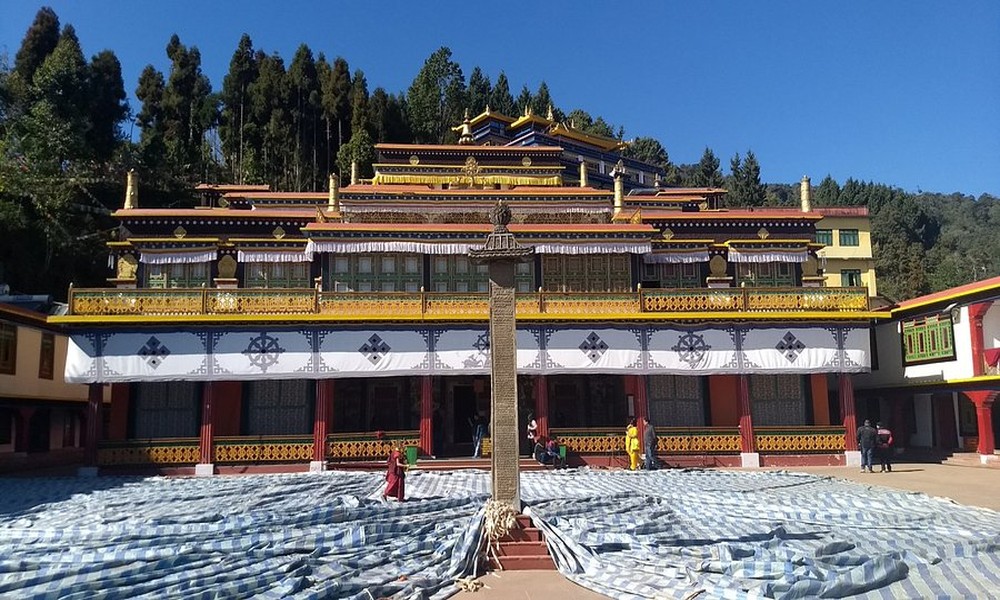
- The base structure of Rumtek Monastery was built strictly according to Tibetan architectural style.
- The monastery is a 3 storeyed building with monk’s quarters, prayer hall and the residence of 16th Karmapa built inside it.
- The rooftop of the monastery is made up of a four storeyed golden structure known as Ghanzira. The Ghanzira is made up of 5 distinctive shapes which represent the five Buddha families.
- The facade of the monastery is designed in softer colours, floral symbols, and curvilinear patterns.
- The entire structure of the monastery is covered in beautiful motifs and frescoes, while the balconies are made of wood, featuring entirely handcarved patterns.
- All in all the below mentioned areas/structures exist within the monastery premises.
- Main Entry
- Courtyard
- Sthambha (Pillar)
- Golden Stupa
- Prayer Hall
- Monk Quarters
- Garden
- Nalanda Institute
- Back Entry
Best Time to Visit Rumtek Monastery
The best time to visit Rumtek monastery is from March to June and October to December. Enjoy the enchanting weather, gorgeous views of mountains, rivers, and streams and more. The timings of the Rumtek Monastery are from 6 AM to 6 PM.
How to Reach Rumtek Monastery?
The best way to reach Rumtek Monastery from Gangtok is to take a taxi from Deorali or get a shared cab to save money. The taxi will pass through scenic hills and villages and will drop you at a point from where you will have to walk uphill for about 500m to 1000 m.
What to See inside Rumtek Monastery?
You can witness the following things inside the Rumtek Monastery:
If you manage to reach the top floor of the monastery, you will get the view of the whole Gangtok city.
Places to Visit Near Rumtek Monastery
Located just 2 mins. away from Rumtek Monastery lies Nehru Botanical Garden. One can go for a stroll there. The garden is filled with tropical and temperate plants and beautiful exotic orchids.
If you plan to visit monasteries in Sikkim like the Rumtek Monastery, contact https://sikkimtourism.org/. They are a local travel partner known for their flexible itineraries, competitive prices, and travel assistance in Sikkim.
